4K IPTV Subscription Guide for USA & Canada 2026
Learn how to choose a 4K IPTV subscription, check legality, test streaming quality, set up Firestick and troubleshoot buffering in the USA and Canada.
4K IPTV Subscription: How to Choose, Set Up, and Use IPTV Safely in the USA and Canada
Table of Contents
What Is a 4K IPTV Subscription?
How IPTV Actually Works
IPTV Provider vs. IPTV Player
What to Look for in a 4K IPTV Subscription
4K Streaming and Internet Speed
Device Compatibility and Firestick Setup
EPG, VOD, Catch-Up, and Other Features
How to Choose an IPTV Subscription
Step-by-Step Setup Guide
Pros and Cons
USA-Specific Considerations
Canada-Specific Considerations
Troubleshooting Buffering and Playback Problems
Privacy and Security
Common Mistakes to Avoid
FAQs
Conclusion
Author Bio
What Is a 4K IPTV Subscription?
A 4K IPTV subscription is a paid internet-based television service that can deliver compatible live television or on-demand video at resolutions up to 4K Ultra HD. Unlike traditional cable or satellite delivery, IPTV uses an internet connection to transfer video to a compatible application, streaming device, smart TV, computer, or mobile device.
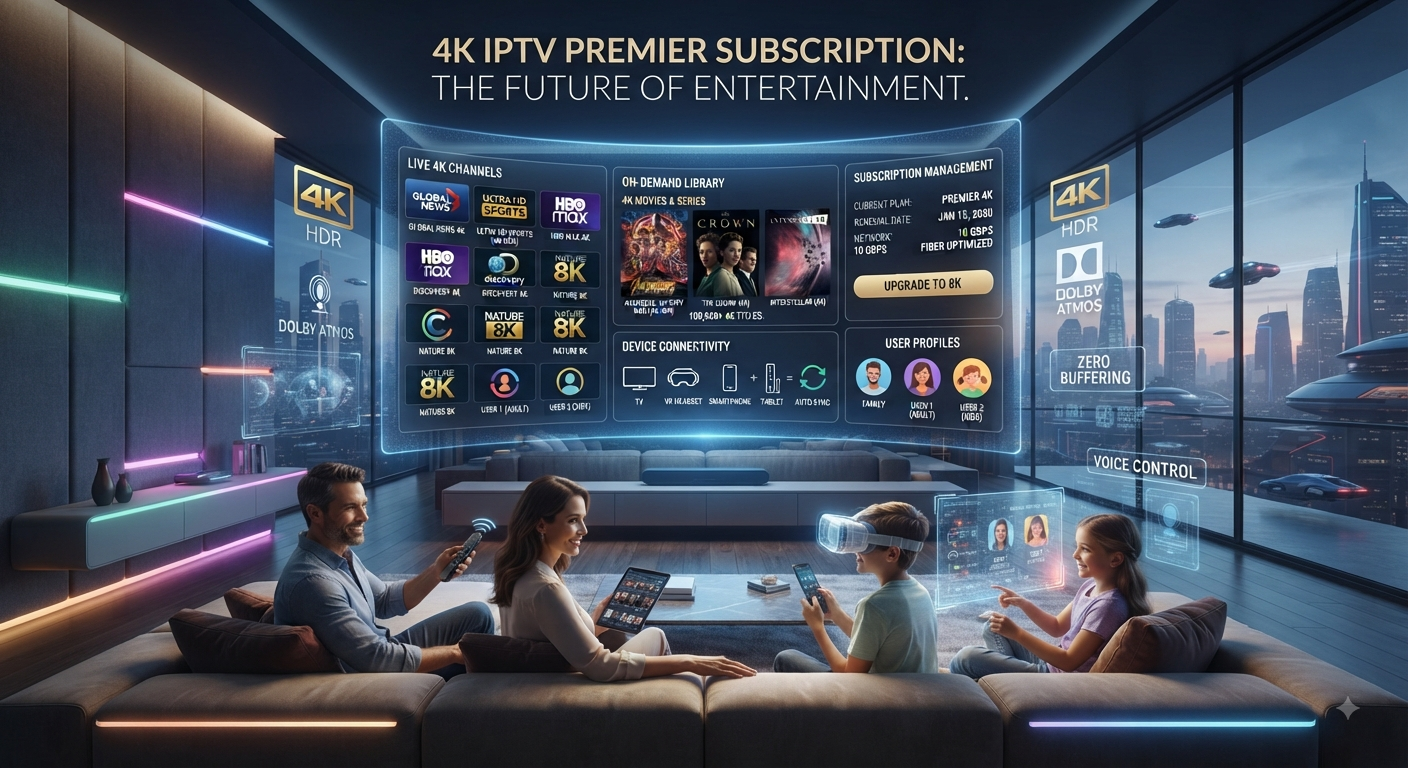
The important distinction is that 4K describes video resolution, not the legality or quality of the IPTV provider itself.
A service may advertise 4K but still provide inconsistent streams, poor source quality, limited device support, or unreliable playback. Likewise, a provider can offer excellent HD streams without offering genuine 4K for every channel.
For shoppers in the USA and Canada, the better question is therefore not simply “Does this IPTV subscription say 4K?” but:
Does the service have the necessary rights to distribute its content, support my device, provide the channels or VOD I actually need, and deliver reliable quality over my connection?
That approach avoids one of the most common mistakes in IPTV shopping: treating a large channel list or “4K” label as proof of service quality.
How IPTV Actually Works
IPTV stands for Internet Protocol Television. At a basic level, it means television or video content is delivered using IP networks rather than traditional broadcast, cable, or satellite distribution.
A typical setup has several separate components:
Component | Main purpose |
|---|---|
IPTV provider | Supplies an authorized television or streaming service |
IPTV player | Plays compatible streams supplied by a provider |
Internet connection | Transfers video data |
Streaming device | Processes and displays the video |
EPG | Organizes program schedules |
VOD system | Provides on-demand movies or programs |
This distinction matters because an IPTV player does not automatically provide television channels.
For example, an application installed on a Fire TV Stick may simply be a playback interface. The actual programming comes from the service or provider connected to that application.
IPTV Is a Delivery Technology, Not a Content License
The term IPTV sometimes causes confusion because it describes a method of delivering content rather than automatically identifying a particular business model.
A legitimate television company can use IPTV technology. A streaming platform can use IP delivery. A provider distributing unauthorized copyrighted broadcasts can also use similar technical infrastructure.
The technology itself does not determine whether the content is authorized.
IPTV Provider vs. IPTV Player
This is one of the most important distinctions to understand before purchasing an IPTV subscription.
IPTV Provider
The provider is responsible for the television or video service being delivered to you. Depending on the service, it may provide:
Live channels
On-demand programming
Electronic program information
Catch-up functionality
Account access
Streaming infrastructure
Customer support
IPTV Player
A player is software used to display compatible content.
Depending on the application, a player may offer:
Channel organization
Favorites
EPG display
Playback controls
Multiple profiles
Parental controls
Subtitle support
A player generally does not make an otherwise unauthorized source legitimate.
Why This Matters
Suppose you install an IPTV player on a Firestick and experience buffering. Reinstalling the player might help if the application itself is malfunctioning, but it will not fix an overloaded provider server.
This gives you a useful troubleshooting principle:
First identify whether the problem comes from the source, the player, the network, or the device.
What to Look for in a 4K IPTV Subscription
A good IPTV subscription should be evaluated on more than channel quantity.
1. Content Rights and Transparency
The first question should be whether the provider has authorization to distribute the programming it sells.
Be cautious when a service makes extraordinary claims without explaining its business, rights, support, or terms.
A legitimate service should give you enough information to understand what you are purchasing rather than relying exclusively on anonymous messaging accounts or vague promises.
2. Actual 4K Availability
“4K IPTV” does not necessarily mean every channel is delivered in native 4K.
A provider may have:
Some 4K channels
4K VOD
Upscaled HD content
HD channels alongside 4K channels
Different quality levels depending on the source
This is why asking which specific content is available in 4K is more useful than asking whether the service is simply “4K compatible.”
3. EPG Quality
An Electronic Program Guide (EPG) can make a major difference to usability.
A useful EPG should ideally show:
Current program
Upcoming programs
Program descriptions
Correct time information
Channel names
Consistent schedule updates
Incorrect time zones or missing program data can make even a technically good service frustrating to use.
4. VOD Organization
If video-on-demand matters to you, look beyond the size of the library.
Useful VOD organization may include:
Movies
TV series
Genres
Search
Recently added content
Favorites
Continue watching
The size of a catalog should not automatically be treated as evidence of quality or legitimacy.
5. Device Compatibility
Check compatibility before purchasing.
Common platforms include:
Amazon Fire TV devices
Android TV
Google TV devices
Smart TVs
Apple TV
Android phones and tablets
iPhone and iPad
Windows computers
macOS computers
Compatibility can vary between the provider and the player. A service that works on Android does not necessarily provide the same application or features on every Smart TV platform.
4K Streaming and Internet Speed
4K video requires more data than lower-resolution streaming, but internet speed is only one part of the equation.
As a practical starting point, many households can use the following targets:
Streaming quality | Practical connection target |
|---|---|
SD | Around 5 Mbps |
HD | Around 10 Mbps |
Full HD | Around 20 Mbps |
4K UHD | Around 30–50 Mbps |
These are practical targets rather than guarantees. Actual requirements vary with compression, bitrate, network congestion, Wi-Fi conditions, device performance, and the streaming source.
A household with a 100 Mbps connection can still experience buffering if the Wi-Fi signal is poor or the provider's server is overloaded.
Don't Confuse Internet Speed With Stability
A speed test measures available throughput at a particular moment.
Streaming also depends on:
Latency
Packet loss
Wi-Fi interference
Network congestion
Server capacity
Route quality
Device performance
For this reason, a stable wired connection can sometimes outperform a faster but inconsistent Wi-Fi connection.
Firestick Compatibility and Setup
The Amazon Fire TV Stick is popular for streaming because it is inexpensive, compact, and designed to connect directly to a television.
However, there is an important distinction between device compatibility and service authorization.
A Firestick can technically run many types of streaming software. That does not mean every source accessed through those applications is authorized.
Basic Firestick Setup
For an authorized IPTV or streaming service:
Connect the Fire TV Stick to your television.
Connect it to power.
Follow the on-screen setup process.
Connect to your home Wi-Fi network.
Install the provider's official application when one is available.
Sign in using your legitimate account.
Configure your preferred playback and display settings.
Test several streams.
Check the EPG and VOD sections if included.
Confirm that playback remains stable during longer viewing sessions.
Avoid installing unknown applications simply because a website promises access to an unusually large amount of premium content.
EPG, VOD, Catch-Up, and Other Features
A modern IPTV subscription can include more than live channels.
EPG
The Electronic Program Guide provides a schedule of programming.
It is especially useful when you want to browse what is currently airing without opening individual channels.
VOD
Video on demand allows viewers to choose content rather than waiting for a scheduled broadcast.
Catch-Up
Some services allow previously aired programs to be replayed for a limited period.
Favorites
Favorites can reduce the time needed to navigate a large channel list.
Search
A strong search feature becomes increasingly valuable as the amount of content grows.
Parental Controls
If children use the device, look for account or application-level parental controls where appropriate.
How to Choose an IPTV Subscription
Instead of starting with price, start with your viewing requirements.
Step 1: Define What You Actually Watch
Write down the categories that matter most:
Local television
News
Sports
Movies
International programming
Kids' content
TV series
On-demand content
A smaller authorized service that covers your actual needs may be more useful than a huge catalog you rarely use.
Step 2: Check Device Support
Confirm that your exact device and operating system are supported.
Do not assume that “Smart TV compatible” means every Smart TV brand and model.
Step 3: Check Quality Requirements
If 4K matters, determine whether the content you care about is actually available in 4K.
Also check whether your television supports the required resolution and whether your network can sustain the stream.
Step 4: Read the Terms
Look for:
Billing terms
Cancellation policy
Supported devices
Account limits
Geographic restrictions
Privacy information
Customer support details
Step 5: Test Before Making a Long Commitment
Where a legitimate provider offers a trial or short-term option, use it to test:
Playback quality
EPG accuracy
Search
VOD
Device compatibility
Support responsiveness
A short test can reveal problems that a sales page will not.
Step-by-Step Guide: Setting Up and Testing IPTV
Once you have selected an authorized IPTV subscription, use this process.
Step 1: Prepare Your Network
Position your router appropriately and, where practical, use Ethernet for a stationary streaming device.
Step 2: Prepare the Television
Set your TV to the appropriate picture resolution and make sure its firmware is current.
Step 3: Install the Authorized App
Use the official app supplied or recommended by the service.
Step 4: Sign In
Enter your legitimate account credentials.
Never share account passwords unnecessarily.
Step 5: Configure the EPG
Check your time-zone settings and allow the application to update its program guide.
Step 6: Test HD First
Before judging 4K performance, test a normal HD stream.
If HD itself is unstable, jumping directly to 4K makes troubleshooting harder.
Step 7: Test 4K
Try a known 4K stream if your subscription and device support it.
Watch for:
Resolution changes
Stuttering
Buffering
Audio/video synchronization
Excessive loading
Device overheating
Step 8: Test During Your Normal Viewing Hours
A service that performs well at noon may behave differently during peak evening usage.
Testing when you actually watch television gives you more useful information.
Pros and Cons of a 4K IPTV Subscription
Pros
High-resolution viewing where genuine 4K content is available
Internet-based delivery
Can work across multiple compatible devices
Potential access to live and on-demand programming
EPG can simplify channel navigation
Can be convenient for households already using streaming devices
No traditional satellite dish is required for internet delivery
Cons
4K availability varies by content
Requires a reliable internet connection
Wi-Fi problems can cause buffering
Device limitations can affect playback
EPG information may sometimes be incomplete
Subscription quality varies substantially between providers
Content availability can change because of licensing
Unauthorized services can create legal, financial, privacy, and security risks
USA-Specific IPTV Considerations
For viewers in the United States, the central issue is authorization.
The U.S. Copyright Office has explained that unauthorized streaming can implicate the copyright owner's public-performance rights.
Enforcement is not merely theoretical. In July 2026, the U.S. Department of Justice announced seizures involving more than 1,000 domains used for unauthorized World Cup streaming.
That makes claims such as “all premium channels for one extremely low price” worth examining carefully.
What U.S. Buyers Should Check
Before subscribing, look for:
Clear business identity
Transparent terms
Official applications where applicable
Copyright and licensing information
Normal payment and cancellation procedures
Accessible customer support
Reasonable claims about content availability
Be particularly cautious with services that ask customers to download unfamiliar software, disable security protections, or use questionable workarounds to access restricted content.
Canada-Specific IPTV Considerations
Canadian consumers should also pay close attention to distribution rights.
The CRTC explains that online content availability can depend on geographic distribution rights. A program may be available in one territory but unavailable in another because the relevant rights were not purchased for that territory.
Canada's copyright framework also protects copyright owners' exclusive rights. The Canadian Intellectual Property Office explains that communicating copyrighted content to the public without authorization can constitute infringement, subject to applicable exceptions and the facts of a particular case.
The regulatory environment for online streaming has also evolved. Certain online streaming services operating in Canada may have registration and other obligations under the modernized broadcasting framework.
What Canadian Buyers Should Check
Canadian customers should consider:
Whether programming is licensed for Canada
Whether the service explains geographic restrictions
Whether billing and cancellation terms are clear
Whether customer support is identifiable
Whether the service uses official applications
Whether privacy information is available
Do not assume that a service is legal simply because its website is accessible from Canada.
Troubleshooting 4K IPTV Buffering
Buffering is one of the most common IPTV complaints, but the cause is not always your internet connection.
Problem: Video Keeps Buffering
Try this sequence:
Test another stream.
Test an HD stream instead of 4K.
Run an internet speed test.
Restart the streaming device.
Restart your router.
Move from weak Wi-Fi to Ethernet if possible.
Close unnecessary applications.
Check whether other household devices are consuming significant bandwidth.
Test again during a different time of day.
Contact the authorized provider if the issue affects multiple streams.
A Useful Diagnostic Trick
If one channel buffers while several others play normally, the problem may be specific to that stream or its source.
If every channel buffers, investigate your network, device, application, or provider connection.
If only 4K buffers while HD works reliably, bandwidth, bitrate, Wi-Fi quality, or device limitations become more likely explanations.
Common IPTV Problems and Solutions
Problem | Possible cause | What to try |
|---|---|---|
App won't open | Application or device issue | Restart and update the app/device |
Buffering | Network or source congestion | Test another stream and connection |
No EPG | Guide data issue | Refresh EPG and verify time zone |
4K stutters | High bitrate or device limitations | Test HD and check device/network |
Audio out of sync | Stream or playback issue | Restart playback and test another stream |
Login fails | Account or credential problem | Verify account details |
VOD unavailable | Provider-side issue | Refresh library or contact support |
App crashes | Memory/software issue | Restart, update, or reinstall from an official source |
Privacy and Security: What to Check Before Paying
A subscription is not just a content purchase. You may also be giving a service access to personal information.
Before entering payment details, check whether the provider explains:
What personal information it collects
How payment information is handled
Whether account data is shared
How long information is retained
How you can close your account
How support contacts are handled
Warning Signs
Be cautious if a service:
Requests excessive personal information
Has no meaningful terms or privacy policy
Uses suspicious payment instructions
Requires security software to be disabled
Demands unknown APK files without a clear reason
Promises impossible content combinations
Uses constantly changing domains without explanation
Pressures you into a long subscription immediately
A legitimate streaming experience should not require you to weaken the security of your own device.
Common Mistakes When Buying a 4K IPTV Subscription
Mistake 1: Choosing the Largest Channel List
More channels do not automatically mean more value.
Focus on whether the channels you actually watch are available, authorized, stable, and supported.
Mistake 2: Assuming “4K” Means Everything Is 4K
A service can advertise 4K while offering only selected 4K content.
Mistake 3: Blaming Wi-Fi for Every Buffering Problem
Buffering can originate from the provider, stream source, player, device, or network.
Mistake 4: Buying the Longest Plan Immediately
A long subscription can be poor value if the service does not work well with your device or viewing habits.
Mistake 5: Confusing the Player With the Provider
Installing a different player does not automatically improve a weak source.
Mistake 6: Ignoring Licensing
A technically impressive service can still be an unsuitable choice if it lacks authorization to distribute the programming.
Mistake 7: Ignoring Device Limits
A television may support 4K while the streaming device, application, HDMI configuration, or particular stream does not deliver it correctly.
How to Get Better 4K Streaming Performance
Once your service is authorized and properly configured, a few practical changes can improve reliability.
Prefer Ethernet When Practical
For a stationary TV, Ethernet removes many variables associated with wireless interference.
Keep the Router Away From Interference
Walls, appliances, distance, and congestion from nearby wireless networks can reduce Wi-Fi performance.
Avoid Unnecessary Background Traffic
Large downloads, cloud backups, game updates, and multiple simultaneous high-bandwidth streams can affect available capacity.
Keep Software Updated
Update the streaming device and authorized application when updates are available through normal channels.
Match Quality to the Situation
If your connection is temporarily unstable, switching from 4K to HD may provide a smoother viewing experience.
The goal is not to force the highest resolution at all times. The goal is stable, enjoyable playback.
FAQs About 4K IPTV Subscriptions
1. What is a 4K IPTV subscription?
A 4K IPTV subscription is an internet-based television or video service capable of delivering compatible content at up to 4K Ultra HD resolution. Actual 4K availability depends on the provider, content source, subscription, application, device, and network.
2. Is IPTV legal in the USA?
IPTV technology itself is not inherently illegal. The important issue is whether the provider has authorization to distribute the copyrighted programming it offers. Unauthorized streaming of copyrighted works can infringe copyright rights under U.S. law.
3. Is IPTV legal in Canada?
IPTV is a technology and delivery method, so legality depends on the service and the content rights involved. Canadian copyright law protects rights holders, while distribution rights can also determine whether particular programming is available in Canada.
4. How fast should my internet be for 4K IPTV?
A practical target is around 30–50 Mbps for a 4K stream, although the actual requirement varies according to bitrate, compression, network conditions, and device performance. Multiple simultaneous streams require additional capacity.
5. Can I use a 4K IPTV subscription on Firestick?
Yes, an authorized IPTV or streaming service can support compatible Fire TV devices. However, compatibility depends on the specific application, device generation, operating system, and provider.
6. Does every IPTV channel come in 4K?
No. A service can support 4K while offering a mixture of SD, HD, Full HD, and 4K content. Always check whether the specific channels or programs you care about are actually provided in 4K.
7. Why does IPTV buffer even when my internet is fast?
Fast internet does not guarantee stable streaming. Buffering can result from Wi-Fi interference, network congestion, provider capacity, stream-source problems, device limitations, or application issues.
8. What is an EPG in IPTV?
EPG means Electronic Program Guide. It organizes channel schedules and may show current programs, upcoming broadcasts, descriptions, and other information. The quality and accuracy of EPG data depend on the service.
9. Is an IPTV player the same as an IPTV provider?
No. An IPTV player is software used to play compatible streams, while an IPTV provider supplies the underlying television or video service. Installing a player does not itself provide licensed programming.
10. Should I buy a yearly IPTV subscription?
Only after you are satisfied that the authorized service meets your needs. If a provider offers a legitimate short-term option or trial, testing device compatibility, streaming quality, EPG performance, support, and content availability first can reduce the risk of committing to a service that does not suit you.
Conclusion
Choosing a 4K IPTV subscription should be less about finding the biggest advertised channel list and more about evaluating the entire viewing experience.
Start by understanding what IPTV actually is and separate the provider from the player. Then check content authorization, device compatibility, genuine 4K availability, EPG quality, VOD functionality, internet requirements, pricing terms, privacy practices, and customer support.
For Firestick and other streaming devices, installation is usually only the beginning. The more important test is whether the service remains stable during your normal viewing hours and whether it works reliably with your network and hardware.
Most importantly, do not treat IPTV technology as a shortcut around copyright or licensing. In the USA, government enforcement has continued against unauthorized streaming operations, including large domain seizures in 2026. In Canada, distribution rights and copyright rules similarly matter when determining whether content can lawfully be made available to viewers.
The best IPTV decision is therefore a practical one:
Understand → Compare → Choose → Install → Set Up → Test → Troubleshoot → Use Safely.
That process is far more reliable than choosing a service solely because it promises “4K,” an enormous channel list, or an unusually low subscription price.
Author Bio
About the Author:
The author is an SEO and streaming-technology content writer focused on producing practical, research-driven guides about IPTV, streaming devices, internet performance, and digital entertainment. Content is written with an emphasis on clarity, responsible technology use, consumer awareness, and current information rather than unsupported provider claims or exaggerated performance promises.
Comment as Guest