Buy IPTV Canada: Safe & Legal IPTV Buying Guide 2026
Buy IPTV Canada: A Practical Guide to Choosing, Setting Up, and Using IPTV Safely
Learn how to buy IPTV Canada safely, compare providers, check legality, install on Firestick and Smart TVs, reduce buffering, and protect your privacy.
Buy IPTV Canada: A Complete Guide for Choosing the Right IPTV Service
If you are planning to buy IPTV Canada, the hardest part is usually not finding a subscription. It is determining whether the service is legitimate, compatible with your devices, reliable enough for everyday viewing, and actually worth paying for.
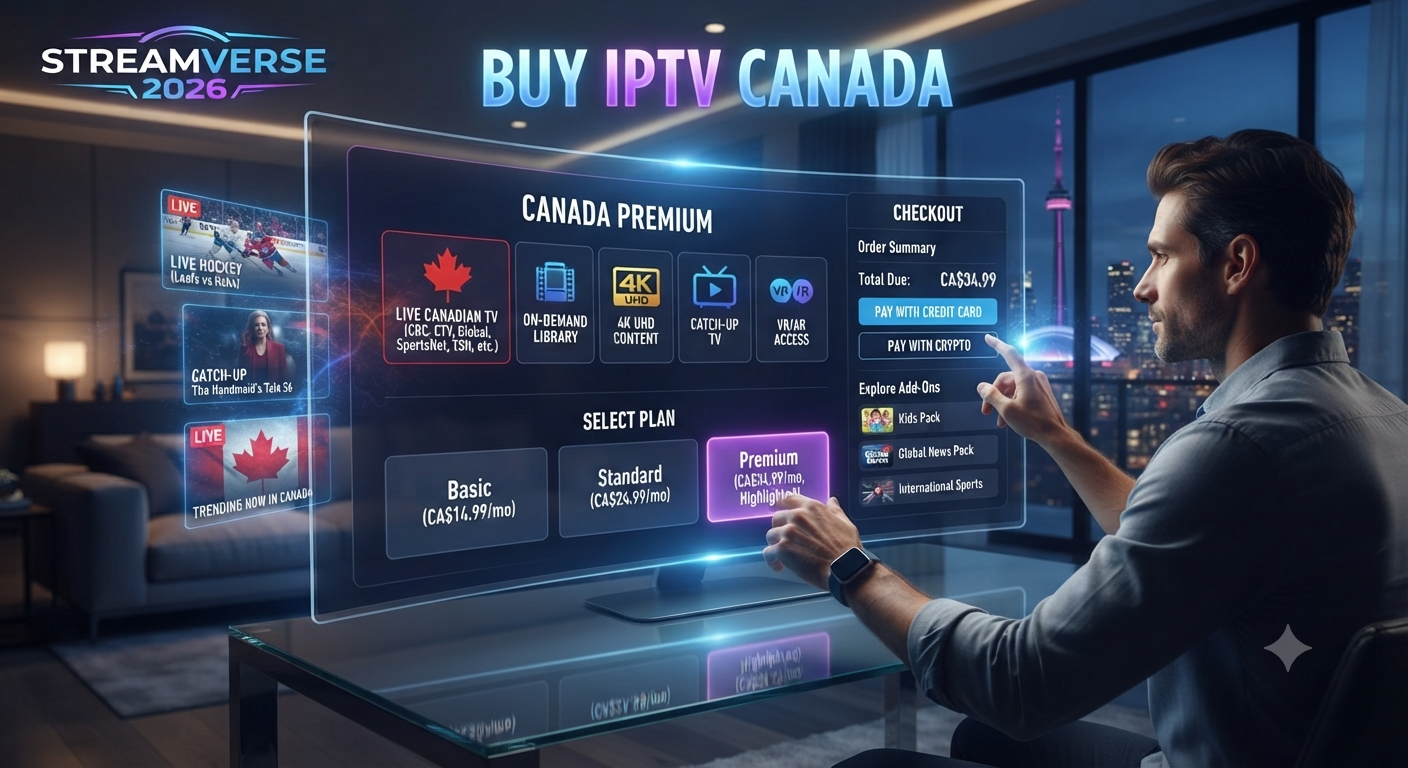
IPTV, or Internet Protocol Television, delivers television and video programming over an internet connection rather than through traditional cable, satellite, or terrestrial broadcast infrastructure. The technology itself is legitimate. The important question is whether the provider has the necessary rights or licenses for the content it distributes.
That distinction matters in both Canada and the United States.
A good IPTV buying decision should therefore go beyond claims such as "thousands of channels," "4K everywhere," or "99.9% uptime." Before paying, you should evaluate licensing, supported devices, EPG quality, VOD organization, streaming performance, customer support, payment security, privacy practices, and cancellation terms.
This guide follows the real customer journey:
Understand → Compare → Choose → Install → Setup → Test → Troubleshoot → Use Safely
Table of Contents
What Is IPTV?
IPTV Provider vs IPTV Player
Is IPTV Legal in Canada and the USA?
What to Look for Before You Buy IPTV Canada
IPTV Features That Actually Matter
Device Compatibility and Firestick Setup
Recommended Internet Speeds
How to Buy IPTV Canada Step by Step
How to Test Your IPTV Service
Buffering and Troubleshooting
Privacy and Security Considerations
Canada-Specific IPTV Considerations
USA-Specific IPTV Considerations
Pros and Cons of IPTV
Common Mistakes to Avoid
FAQs
Conclusion
Author Bio
What Is IPTV?
IPTV stands for Internet Protocol Television. Instead of receiving television programming through a traditional cable or satellite signal, IPTV uses an internet connection to deliver video to a compatible application or device.
Depending on the service, IPTV may provide live television, video-on-demand (VOD), catch-up programming, electronic program guides (EPG), and other features.
However, IPTV is a delivery technology rather than a guarantee that every service using it is legitimate.
A licensed streaming provider can use internet-based delivery legally, while a provider distributing copyrighted programming without authorization can create copyright issues.
This is why choosing an IPTV service should begin with content rights and provider transparency, not simply channel quantity.
IPTV Provider vs IPTV Player: What Is the Difference?
This is one of the most important distinctions to understand before you buy IPTV Canada.
What Is an IPTV Provider?
An IPTV provider supplies the actual television or video content. Depending on its business model, the provider may operate the streaming infrastructure, license programming, provide subscriber credentials, or bundle several services together.
Your subscription is generally with the provider.
What Is an IPTV Player?
An IPTV player is software that plays content you are authorized to access.
Examples include applications designed for Smart TVs, Android devices, Fire TV devices, computers, tablets, or phones.
A player typically does not supply television channels by itself.
Think of it this way:
Component | Main Function |
|---|---|
IPTV provider | Supplies authorized content/service access |
IPTV player | Plays compatible streams |
Internet connection | Transports the data |
Streaming device | Displays or processes the content |
EPG | Organizes program schedules |
VOD library | Organizes on-demand content |
A common mistake is assuming that installing an IPTV player automatically provides channels. It does not.
Is IPTV Legal in Canada and the USA?
IPTV technology is legal. The legality of a particular IPTV service depends largely on whether the provider has authorization to distribute the content it offers and whether users are accessing content lawfully.
In Canada, copyright owners have exclusive rights over activities such as reproducing and communicating copyrighted works to the public. Canadian government guidance explains that unauthorized use of protected content can constitute copyright infringement.
Canada also operates a "Notice and Notice" framework under which copyright owners can send alleged infringement notices through internet service providers. Receiving a notice is not itself a court finding of infringement, but it is a reason to take the issue seriously.
In the United States, copyright law similarly protects rights holders, while the Digital Millennium Copyright Act includes provisions addressing unauthorized access and circumvention of technological protection measures.
What Should You Check?
Before subscribing, look for evidence that the service:
Clearly identifies the company operating it
Explains its content licensing or distribution rights
Provides legitimate customer support
Uses secure payment methods
Publishes clear terms and conditions
Has a transparent refund or cancellation policy
Does not instruct customers to bypass content protections
Does not market unauthorized premium channels as a guaranteed bargain
If a provider refuses to explain where its content comes from, that is a significant warning sign.
Important: This article is general information, not legal advice. Copyright rules can depend on the specific content, provider, activity, and jurisdiction.
What to Look for Before You Buy IPTV Canada
A professional-looking website does not automatically make an IPTV provider trustworthy.
Before purchasing, evaluate the service using several independent criteria.
1. Content Legitimacy
This should be your first filter.
A huge channel list is meaningless if the provider cannot lawfully distribute the programming.
Look for clear information about the provider's business identity, licensing, and content rights.
2. Device Compatibility
Check whether the service supports your actual equipment.
Common platforms include:
Amazon Fire TV devices
Android TV
Google TV
Smart TVs
Apple TV
Chromecast-compatible devices
Android phones and tablets
iPhone and iPad
Windows computers
macOS computers
Compatibility can vary between the provider and the player, so verify both.
3. EPG Quality
An Electronic Program Guide (EPG) displays information about upcoming programming.
A useful EPG should have:
Correct program names
Accurate schedules
Appropriate time zones
Logical channel organization
Regular updates
A service with an enormous channel list but an unreliable EPG can be frustrating to use.
4. VOD Organization
If you care about movies and series, examine how the VOD library is organized.
Useful features include:
Categories
Search
Genre filtering
Recently added titles
Resume watching
Clear metadata
Multiple language options where legitimately available
More VOD titles do not necessarily mean a better service.
IPTV Features That Actually Matter
Live TV
Live television is generally the core feature. Evaluate channel organization, stream stability, picture quality, and whether the channels you legitimately need are available in your region.
VOD
Video-on-demand lets you watch available programming when you choose rather than according to a broadcast schedule.
EPG
EPG can make a large service significantly easier to navigate.
Catch-Up TV
Some providers offer replay or catch-up functionality for selected programming. Availability depends on the provider and the rights attached to the content.
1
Some services advertise multiple simultaneous connections.
Do not automatically assume that "multiple connections" means unlimited household streaming. Check the provider's actual terms and whether the feature is permitted for your account.
Firestick Compatibility and Installation
The Amazon Fire TV Stick is popular because it provides a relatively simple way to add streaming applications to a television.
However, there are two separate questions:
Does your IPTV provider support Fire TV?
Is the application you intend to use officially available and compatible with your Fire TV model?
Basic Firestick IPTV Setup
For a legitimate IPTV application:
Connect your Fire TV Stick to the television.
Connect it to your Wi-Fi network.
Sign in to your Amazon account.
Install a compatible IPTV player from an appropriate source.
Open the player.
Enter the credentials or playlist information supplied by your authorized provider.
Allow the application to load its available content.
Configure EPG and playback settings if supported.
Test several streams.
Confirm that everything works before relying on it for regular viewing.
Avoid installing random APK files from unknown websites simply because a guide promises access to more channels.
The FTC has warned that illegal streaming applications and add-ons can expose users to malware and security risks.
Recommended Internet Speeds for IPTV
Your internet plan is only one part of streaming performance, but insufficient bandwidth can cause obvious problems.
Quality | Practical Target |
|---|---|
SD | Around 5 Mbps or more |
HD | Around 10 Mbps or more |
Full HD | Around 20 Mbps or more |
4K UHD | Around 30–50 Mbps or more |
These are practical targets rather than universal guarantees.
Actual performance depends on:
Wi-Fi quality
Network congestion
Router performance
Distance from the router
Number of devices using the connection
Server-side capacity
Video encoding
Stream bitrate
Device performance
A 100 Mbps internet connection does not guarantee a smooth 4K stream if the Wi-Fi signal is poor or the content server is overloaded.
How to Buy IPTV Canada Step by Step
Step 1: Identify What You Actually Need
Before comparing providers, list your requirements.
For example:
Live television
Canadian programming
U.S. programming
Sports that you are authorized to watch
Movies
VOD
EPG
Firestick support
Smart TV compatibility
One or multiple permitted household devices
This prevents you from paying for features you will never use.
Step 2: Check the Provider's Identity
Look for a real business identity and accessible support information.
Be cautious if a provider only communicates through temporary messaging accounts and gives no meaningful information about the company behind the service.
Step 3: Investigate Content Rights
Ask a simple question:
"Are you authorized to distribute the channels and content you advertise in my region?"
A legitimate provider should be able to explain its rights or licensing arrangements without telling you how to circumvent restrictions.
Step 4: Check Device Support
Confirm compatibility with your exact device rather than relying on a generic "works everywhere" statement.
Step 5: Review the Terms
Read:
Subscription duration
Renewal conditions
Refund policy
Cancellation process
Number of permitted devices
Simultaneous-stream restrictions
Privacy policy
Customer support terms
Step 6: Choose the Smallest Sensible Commitment
If a legitimate provider offers different subscription periods, a shorter commitment can be useful when you are evaluating service quality for the first time.
Avoid paying for a long-term subscription solely because a large discount is advertised.
Step 7: Install the Recommended Player
Use the provider's legitimate setup instructions and a compatible IPTV player.
Step 8: Test Before Depending on It
Test live television, EPG, VOD, audio, subtitles where applicable, and different times of day.
Step 9: Monitor Performance
A service that works perfectly for ten minutes is not necessarily reliable.
Look for repeated buffering, failed streams, missing EPG data, authentication errors, and unexplained disconnections.
How to Test an IPTV Service Properly
Instead of asking only "Does it work?", run a small practical test.
Test 1: Channel Loading
Open several channels rather than just one.
Test 2: EPG
Check whether program information matches the actual schedule.
Test 3: VOD
Open several categories and verify that navigation and playback work as expected.
Test 4: Picture Quality
Look for:
Pixelation
Sudden resolution changes
Audio/video synchronization problems
Excessive compression
Test 5: Network Stability
Try the service during different periods.
If performance deteriorates only when your household network is busy, your home network may be part of the problem.
Test 6: Device Compatibility
If you plan to watch on a Firestick and Smart TV, test both rather than assuming identical performance.
IPTV Buffering: Troubleshooting Guide
Buffering is one of the most common IPTV complaints, but it does not always mean the provider is bad.
Use this troubleshooting order.
1. Test Your Internet
Run a speed test near the device experiencing problems.
2. Restart the Network
Restart your router and streaming device.
3. Move Closer to the Router
Weak Wi-Fi can cause packet loss and inconsistent throughput.
4. Use Ethernet Where Practical
A wired connection can provide greater consistency than congested Wi-Fi.
5. Reduce Network Load
Pause large downloads, cloud backups, gaming updates, or other high-bandwidth activity.
6. Test Another Stream
If one channel buffers while others play normally, the problem may be specific to that stream.
7. Check the Time of Day
If many streams become unstable simultaneously during certain periods, server-side congestion may be involved.
8. Check the Player
Try the provider's recommended compatible player if your current application is malfunctioning.
9. Update the Device
Outdated software can cause compatibility problems.
10. Contact Support
If your internet connection is stable and multiple streams consistently fail, provide the provider with useful technical information instead of simply reporting "IPTV doesn't work."
Mention:
Device
Player
Error message
Affected content
Approximate time
Wi-Fi or Ethernet
Whether other streams work
Privacy and Security When Using IPTV
Streaming services require you to think about more than video quality.
Use Strong Account Credentials
Do not reuse an IPTV account password on banking, email, or other important accounts.
Be Careful With Unofficial Apps
Unknown applications can introduce security risks.
The FTC has specifically warned that pirate streaming apps and add-ons can contain malware capable of stealing information or compromising connected devices.
Check App Permissions
An application intended primarily for video playback should not casually demand access that appears unrelated to its function.
Keep Devices Updated
Install operating-system and security updates for your Fire TV, Smart TV, phone, computer, or streaming box.
Protect Payment Information
Use reputable payment channels and avoid sending unnecessary financial information through informal messaging services.
Canada-Specific IPTV Information
If you are looking to buy IPTV Canada, consider more than whether a provider advertises Canadian channels.
Canadian viewers may care about:
Canadian news
English-language programming
French-language programming
Regional content
Local time-zone accuracy
Canadian sports rights
Accessibility features
Reliable customer support
Content availability can also vary because distribution rights are often territorial.
A provider advertising a channel does not automatically prove that it has the right to distribute that channel in Canada.
Canadian copyright guidance makes clear that unauthorized use of protected works can constitute infringement, while enforcement and the precise legal outcome depend on the circumstances.
For Canadian households, therefore, licensing transparency should be part of the buying decision, not an afterthought.
USA-Specific IPTV Information
American users face similar considerations.
The United States has a comprehensive copyright framework under Title 17, and the DMCA addresses both copyright enforcement mechanisms and certain forms of unauthorized access or circumvention.
When evaluating IPTV for a U.S. household, consider:
Whether the provider is authorized to distribute its programming
Regional availability
Device compatibility
Streaming quality
EPG time-zone settings
Subscription terms
Privacy practices
Customer support
Payment security
Do not assume that a service is legal simply because it is accessible from a U.S. IP address or has a professional-looking website.
Pros and Cons of IPTV
Pros
Internet-based delivery
Works across many modern devices
Can combine live and on-demand viewing
Often offers flexible interfaces
EPG can simplify channel navigation
Compatible with streaming-focused households
Can reduce reliance on traditional television hardware
Cons
Performance depends on internet and network quality
Service quality varies significantly between providers
Some services have poor EPG data
Device compatibility is not universal
Unclear licensing can create legal concerns
Unofficial apps can introduce security risks
Customer support quality can vary
VOD libraries may change over time
Geographic rights can limit content availability
The biggest lesson is simple: IPTV is not automatically good or bad. The provider, content rights, technology, and way you use it determine the experience.
Common Mistakes When Buying IPTV Canada
Mistake 1: Choosing the Biggest Channel Number
A massive channel count sounds impressive, but it does not tell you whether the content is licensed, relevant, stable, or actually available when you need it.
Mistake 2: Ignoring Licensing
This is the most important mistake to avoid.
Mistake 3: Buying a Long Subscription Immediately
A lower monthly equivalent does not necessarily make a long commitment better.
Mistake 4: Blaming the Provider for Every Buffering Problem
Your Wi-Fi, router, device, or household network may be responsible.
Mistake 5: Installing Random APKs
Unknown software can create unnecessary security risks.
Mistake 6: Confusing the Player With the Service
Installing an IPTV player does not give you television content.
Mistake 7: Ignoring Device Limitations
A service may work on Android TV but behave differently on a particular Smart TV platform.
Mistake 8: Failing to Read Renewal Terms
Understand whether subscriptions renew automatically and how cancellation works.
Mistake 9: Assuming 4K Is Always Better
A 4K label is meaningless if the stream is unstable, highly compressed, or your display cannot take advantage of it.
Mistake 10: Sharing Credentials Improperly
Follow the provider's permitted device and account rules rather than assuming one subscription can be freely shared.
Practical Tips for a Better IPTV Experience
Use Ethernet when possible. A wired connection can eliminate many Wi-Fi-related variables.
Keep your router reasonably modern. Streaming quality depends on the entire network path, not just your internet package.
Choose the right video quality. If your connection struggles with 4K, a stable HD stream can provide a better viewing experience.
Keep EPG settings accurate. Incorrect time-zone settings can make a perfectly functioning service appear unreliable.
Test before committing. When a legitimate provider offers a trial or short-term option, use it to evaluate actual performance.
Document technical problems. Recording the time, device, stream, and error message makes support conversations much more productive.
Treat unusually aggressive claims as warning signs. Promises of every premium channel, every sports event, unlimited devices, and perfect uptime deserve scrutiny rather than immediate trust.
Frequently Asked Questions
1. Is IPTV legal in Canada?
IPTV technology itself is legal. The important issue is whether the provider is authorized to distribute the copyrighted programming it offers. Canadian copyright law protects rights holders, and unauthorized use can create infringement issues depending on the circumstances.
2. Is IPTV legal in the USA?
Yes, legitimate IPTV services can operate legally in the United States. However, accessing or distributing copyrighted content without authorization can raise copyright concerns. U.S. copyright law also addresses unauthorized access and circumvention of technological protection measures.
3. What should I check before I buy IPTV Canada?
Check content licensing, provider identity, supported devices, EPG quality, VOD features, payment security, privacy policies, cancellation terms, customer support, and the number of permitted devices.
4. Can I use IPTV on a Firestick?
Many legitimate IPTV services and compatible players support Fire TV devices. However, compatibility depends on the specific service, application, and Fire TV model. Use legitimate installation methods and avoid unknown applications.
5. Does IPTV require fast internet?
IPTV requires a stable internet connection, and higher video resolutions generally require more bandwidth. As a practical starting point, HD may need around 10 Mbps or more, while 4K can require roughly 30–50 Mbps or more depending on the stream.
6. Why does my IPTV keep buffering?
Buffering can result from weak Wi-Fi, network congestion, insufficient bandwidth, overloaded streaming infrastructure, device limitations, or problems with a particular stream. Test your network and multiple streams before concluding that the provider is responsible.
7. What is an IPTV player?
An IPTV player is software that displays compatible streaming content. It generally does not provide the channels itself. You still need an authorized content source or provider.
8. Is a cheap IPTV subscription always a good deal?
No. A low price may come with poor support, unstable streams, weak EPG data, limited compatibility, unclear renewal conditions, or questionable content rights. Compare the whole service rather than the subscription price alone.
9. Should I choose 4K IPTV?
Only if your display, device, network, and the legitimate content source support it. Stable HD can be preferable to unreliable 4K, especially on a busy household network.
10. Can I use one IPTV subscription on multiple devices?
That depends on the provider's terms. Some subscriptions may permit multiple devices or simultaneous connections, while others restrict account usage. Always follow the provider's stated limits rather than assuming multiple connections are unlimited.
Conclusion: How to Buy IPTV Canada With Confidence
The best way to buy IPTV Canada is not to chase the provider advertising the largest channel list or the lowest price.
Start with legality and transparency. Then evaluate compatibility, streaming performance, EPG, VOD, internet requirements, customer support, privacy, security, and subscription terms.
For Firestick and Smart TV users, confirm that both the provider and the chosen player support your exact device. For buffering problems, troubleshoot your home network before automatically replacing the service. And for Canadian and U.S. viewers alike, remember that the legality of IPTV depends on how the service obtains and distributes its content—not simply on the fact that the content is delivered over the internet.
A sensible IPTV buying process is:
Understand the technology → verify the provider → check content rights → compare features → confirm device compatibility → choose an appropriate subscription → install safely → test performance → troubleshoot methodically → use the service responsibly.
That approach may take a few more minutes before you subscribe, but it can prevent much bigger problems later.
Author Bio
About the Author
The author is an SEO and streaming-technology content specialist focused on producing practical, research-driven guides about IPTV, connected TV platforms, streaming devices, and digital entertainment. Content is written with an emphasis on accuracy, responsible technology use, user experience, and clear explanations rather than unsupported service claims.
Comment as Guest